
Since that strange dead calm moment some days ago, we’ve been sailing at a good speed. When the wind returned, it returned with force.
“We went looking for where it had gone,” said the captain.
Then he explained everything to me with the sarcastic patience of someone who knows he is speaking to a person who probably understands only half of what is being said. We had headed a little farther south to escape a high-pressure system and avoid any stubborn iceberg that might have decided to venture farther south than it ought to; now we were making our way west, and later we would turn northwest towards Nova Scotia.
“The shortest route is rarely the fastest,” he said. “Especially when the wind seems to have a mind of its own.”
We were making good speed, sailing with the wind on the quarter. Another opportunity for a sailing TED Talk: a quartering wind is the fastest point of sail and, at some stage, someone in Portugal probably began using the expression “to put oneself on the quarter (pôr-se na alheta)” as a systematic way of saying “to leave efficiently.”
It was then that Johnny Locke, with the enthusiasm of a man who enjoys coincidences, offered another explanation for the captain’s successful navigation.
“Maybe it’s because it was your Saint Anthony’s Day. Perhaps a miracle brought the wind back.”
A silence of expectation followed. Locke is a bit of a pious character, and I confess I could not tell whether he was joking or being entirely serious. At that, Captain Jackdaw let out a long laugh, almost disproportionately so.
“Saint Anthony is more about broken clay pots and rushed marriages,” he said, still laughing. “Miracles belong to a different department. The Popular Saints are more about… festive logistics. And politics.”
Hobbes raised his head as if someone had called his name.
“I don’t understand,” he said.
The captain did not answer immediately. He leaned against the rail, looked out at the sea, and then spoke in the patient tone of someone about to dismantle an idea.
“The Lisbon Festivities are a good example of how a tradition is constructed without appearing to have been constructed,” he began. “Before they became the Popular Saints celebrations, they were bonfires. Before they became processions, they were rituals. Solstices, fertility rites, the cycles of the earth. Things too old to fit neatly inside a church, yet useful enough not to be destroyed.”
He paused briefly.
“So the Catholic Church did what it has always done, and what other churches do as well. It did not erase them; it reinterpreted them. Later, the dictatorship of Estado Novo regime did much the same. It imposed a discursive order and turned them into a parade. It choreographed spontaneity.”
I looked at him.
“Choreographed… meaning controlled?”
He smiled.
“The difference is more semantic than real.”
Hobbes frowned.
“But are you saying the celebrations were… invented?”
“Reorganised,” corrected the captain. “Inventing something from scratch is inefficient. Much better to take something that already exists, filter it, repackage it, repeat it, and eventually present it as tradition. The more often you repeat it, the older it appears.” He paused. “Have you ever heard of Hobsbawm?”
Hobbes, visibly confused, looked first at Locke and then at Russo, as if trying to confirm whether he was the only one failing to follow.
“Who?”, he asked.
“Eric Hobsbawm,” said the captain. “He and Terence Ranger wrote precisely about this. They described traditions that appear ancient but are, in fact, relatively recent, constructed in order to create continuity with a past that never quite existed in that form.”
“Exactly!” I interrupted enthusiastically. “It’s like history films!”
Jackdaw pointed at me, pleased that someone was keeping up with the lesson.
“There you have it. An excellent example.”
“Like what?”, Hobbes asked, still trying to grasp the thread of the conversation.
“The kilt in Braveheart!”, I replied, expecting the point to be obvious.
Hobbes frowned.
“I vaguely remember it, I think. What’s wrong with it?”, he asked with a shrug.
“It wasn’t worn in that period,” I explained. “It’s a later symbol projected backwards in time. The whole battle-against-the-English scene feels authentic, but it’s a classic Hollywood illusion.”
“First they forbid your tradition. Then they give it back to you… better dressed,” the captain remarked dryly.
Captain Jackdaw leaned back, resting his elbows on the rail.
“That’s essentially what happened with the Popular Saints festivities. What today appears to be an immemorial tradition is, in part, an invented narrative, to use Hobsbawm term. A blend of ancient paganism, Christian devotion, and dictatorship propaganda. If you can convince people that something is ancient, natural, inherited, then it becomes difficult to question. You’re no longer imposing a rule; you’re merely ‘respecting a tradition.’”
“And anyone who disagrees appears to be going against something sacred,” I added.
He nodded.
“But is there any tradition that isn’t invented?”, Russo interjected.
The question lingered in the air.
“Perhaps not in a pure sense,” replied the captain. “But there are practices that emerge organically and are later appropriated and redefined.”
Hobbes folded his arms.
“But why go to all that trouble? Why not just let things happen naturally?”
The captain looked at him with genuine interest.
“Because ‘naturally’ doesn’t work when you need to govern large numbers of very different people at the same time.”
He paused before continuing.
“And this is where Ernest Gellner comes in. Gellner realised that this isn’t merely a matter of inventing traditions. The point is that traditions became necessary with modernity.”
“Huh?”, grunted Hobbes.
Russo was listening intently and gestured for Hobbes to let the captain continue.
“Before modernity,” the captain said, “there was no need to create a common culture. You had villages, regions, different languages. That worked because people rarely mixed. Life was local.”
“The Romans attempted to impose a common institutional and linguistic framework throughout the empire,” said Russo. “But I think I see where you’re going. And then?”
“Then came industrialisation. And everything changed.”
He straightened slightly, as though aligning an invisible chart.
“Suddenly, you need people who are mobile, who can work in factories, move between cities, communicate quickly with strangers. You need people who don’t depend on local customs in order to function.”
“Interchangeable,” murmured Locke.
“Exactly,” said the captain, nodding. “And for that, you need a common culture. You want to prevent dissent and even riots.”
I looked at him and tried to complete the argument.
“Language, education, shared references…”
“Everything standardised,” he continued. “And that doesn’t emerge naturally. It has to be built, taught, repeated.”
He looked at us. Hobbes leaned forward with a troubled expression.
“This sounds counterintuitive… So nationalism…”
“Doesn’t come from the past,” the captain interrupted. “It comes from that need. First you need unity; then you build a story that says it was always there.”
I gazed out at the sea.
“There’s something that intrigues me,” Russo interrupted, folding his arms. “You talk about tradition as if it were an idea, but what I see at these festivities are bodies. People moving, dancing, marching.”
The captain leaned forward, arms spread wide, and slowly brought his hands together in front of him.
“The festivities are where that need meets its representation. They are moments when a shared culture becomes visible.”
He paused.
“The marches, for example. They’re not spontaneous; they’re collective choreography. Once again, rehearsed, repeated, refined. Like an instrument.”
He paused again to see whether we were following.
“It is repetition as conditioning. Because once the body learns, it stops questioning.”
Hobbes straightened up as though he had suddenly woken.
“Like the…,” he snapped his fingers. “The… damn it, what’s his name? The bloke who got thrown in jail by PETA for torturing animals and ringing bells…”
“Pavlov?” suggested Locke.
“That’s it!” exclaimed Hobbes.
“And the costumes?” asked Russo, his eyes fixed on the captain while making a gesture for Hobbes to settle down.
“Uniforms,” replied the captain, provoking a puzzled reaction from Russo. “This is the militarist answer to an old question: how do you turn individuals into a collective body? The answer is ritual. Militarism develops rigorous ceremonies, symbolic uniforms, and repeated gestures such as salutes, marches, and the uniforms themselves. All of this creates a shared identity and a sense of belonging while eliminating irrelevant differences.”
Russo laughed.
“I never thought I’d hear a street festival described as a military barracks.”
The captain gave a knowing smile.
“And the songs?”, I continued.
“The lyrics are fundamental,” the captain pointed out. “Simple, repeated, easy to memorise. They talk about the neighbourhood, the people, the city. They tell you what ought to be celebrated.”
“An emotional script,” said Russo, nodding in agreement.
Silence followed.
Hobbes finally spoke.
“So all of that – the steps, the clothes, the songs – is invented to control and learned by the people?”
“Yes,” said the captain. “And the earlier you learn it, the less you remember having learned it.”
I looked at him.
“Perhaps collective memory is just forgotten education,” I suggested.
He smiled.
“The best tradition is the one nobody remembers learning.”
Hobbes shook his head.
“This is starting to sound like a prison.”
Captain Jackdaw smiled, almost tenderly.
“Only if you try to leave.”
“And if I don’t?” asked Hobbes.
The captain gave a mischievous smile, gauging Hobbes’s reaction.
“Then it’s called culture,” he replied, winking.
Hobbes stood up, stretched his legs, and turned towards the sea as though trying to ignore the conversation. The wind had eased somewhat, but the Nómada continued to make steady progress. Russo leaned back against the stern pulpit, his legs resting on the bench.
“And yet… people seem happy.”
The captain shrugged.
“The need is real. Belonging, repeating, celebrating… that isn’t invented.”
“Only the form,” I said.
“Only the form,” he confirmed.
Hobbes turned back towards the group as though he had suddenly grasped something.
“So then, what exactly is the difference between a real tradition and an invented one?”
“Effectiveness,” Captain Jackdaw replied promptly, without irony.
The silence that followed was long, but not heavy. The captain stood up.
“And speaking of that, it’s time to check how efficiently the sails are trimmed and what sort of drift we’re making.”
I looked out at the dark sea and thought of the streets of Lisbon, the lights, the sardines, the voices singing lyrics that nobody had written alone. I kept my eyes on the horizon. And for a moment, I thought I could smell grilled sardines.
I turned with a start but realised it was only memory trying to play a trick on me. Just as the taste of a madeleine awakens journeys into the past, there are scents that remain alive in the mind, clinging to memories.

"Give me a sardine for me to dine"
The songs of the Popular Saints are among the most recognisable features of the festivities. Passed from mouth to mouth and from year to year, they come to sound ancient even when they have been adapted or reinvented.
From Street to Church
The Popular Saints celebrations emerged from a long process of historical reinterpretation of ancient festive practices. Fernando Pessoa, born on the same day and carrying the same names as Lisbon’s patron saint, resisted their appropriation by both the Estado Novo and the Catholic Church, and sought to recover the pagan, Dionysian, and popular spirit of the festivities in his triptych Praça da Figueira.

Traditionalised Cinema
During the Estado Novo, Portuguese cinema played a significant role in constructing and disseminating a standardised national identity. It helped to consolidate a recognisable and repeatable image of what it meant to be Portuguese; an image that remains influential and immediately recognisable today.
Excluindo as imagens criadas pelo autor deste blog, as imagens utilizadas neste post têm as seguintes lincenças:
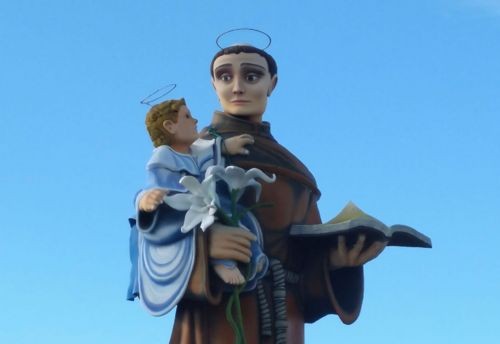
Santo António (Estátua em Gouveia): by Valentim0106, CC BY-SA 4.0 <https://creativecommons.org/licenses/by-sa/4.0>, via Wikimedia Commons https://commons.wikimedia.org/wiki/File:Est%C3%A1tua_de_Santo_Ant%C3%B4nio_em_Gouveia.png


Termos e Condições