Sorry for the interruption, it was a call from my boss. She says she wants to speak to me in person, probably to fire me. The thing is, yesterday, after she sent me that message, I really did end up not sending her the work. I’ll explain, let me try to pick up the thread again.
After giving getting fine, I stayed there, rooted in front of the library, the ticket in my hand, thinking about what had just happened. That whole business with the apologies kept nagging at me, like an itch at the back of my mind. What kind of theatrical trio were they, to take offence so readily, as though I had stumbled into some old tale where only a duel could settle matters? And who exactly was Ms Lortz, the new librarian?
“Is it possible for a character to step off the page and be turned into flesh and blood… and who knows what else?”, I wondered.
That was when I realised, in sheer horror, that I had slung over my shoulder, in my linen tote, the books I had taken from the shelves to borrow. If those who damage a book suffer a punishment worse than the suspension of reading privileges, what must await someone who walks out of a library with books without authorisation?
I stood there, frozen, unsure what to do. I didn’t want to go back inside and run into those unpleasant figures to whom I had promised an apology. Worse still, I could not imagine explaining to Ms Lortz that it had all been a terrible mistake, that I had left with the books absent-mindedly because of the imminent parking fine, and that I was now returning to put them back. Of course, I would accept the suspension of borrowing rights with the beatific smile of a nun properly admonished with a good dozen Hail Marys and Our Fathers… no, no no, not even I was convinced by such self-pity. What was I to do?
I fixed my gaze on the library entrance, my heart racing with the sudden awareness that, at any moment, Ms Lortz, or someone worse, might appear looking for me. I glanced around, almost instinctively, searching for somewhere to hide, and noticed the terrace café right beside the library. It might not be a bad idea to sit there for a while, take control of the situation, and put a brake on the panic that was beginning to take hold of my thoughts. Better to sit down, enjoy something, and let all that negative energy drain out of me and seep into the cracks of the pavement.
“And as for the work, whether I send it before or after midnight makes no difference,” I concluded.
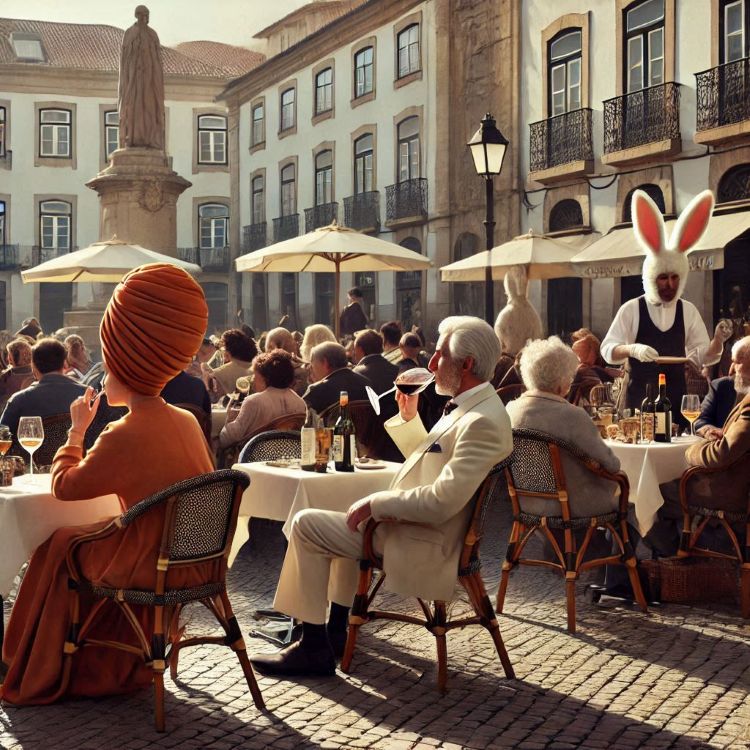
You probably know the café. It is one of those places with modest indoors but generous outdoor terraces, where idle customers, especially tourists and comfortably retired professionals, devote themselves to the social labour of drinking and talking. A double pleasure that so neatly replaces scrolling on a phone. Behind the small crowd at the terrace rises, in a decidedly carnivalesque note, the café’s entrance: a monstrous white rabbit’s head, with ears that seem intent on reaching the second floor, and a mouth fixed in an open grin. From inside emerge, with the composure of those who have traded dignity for tips and made peace with the ridiculous, waiters dressed smartly but adorned with a pair of fake rabbit ears and a fluffy white tail that flicks against their trousers at every step.
The café had not always been like this. It was the new owner, a bunny-obsessed American woman by the name of Hughla Hefny, who remodelled the entrance and indulged her fetish for having men dressed as rabbits. On one of the rare occasions she appeared to oversee her husband’s management of the place, her voice rang across the tables, silencing every conversation as she shouted at him “I only ever asked God that you might be a rabbit!”. No one knew whether she meant to roast him or whether she had had other expectations when she first met him…
I spotted an empty table by the entrance and was about to sit down when I heard a voice calling out to me.
“Mademoiselle! Eh, Mademoiselle!”
Instead of a tourist asking for directions, I saw a man waving at me from another table, accompanied by a woman with a long turban that made her appear even taller than him. I approached to see what they wanted.
“You dropped your book over there.”
I placed my things on the chair opposite them, hurried to pick up the slim volume that had fallen from my bag, and returned to thank the pair.
“What are you reading, Mademoiselle? Do tell me whether I have prevented a tragedy or committed an even greater disaster.”
His smile, tucked into his shoulders, reminded me of Kermit the Frog. He wore thick-lensed glasses, and one eye wandered slightly. His straight hair was greying, and he was dressed in a light grey suit, brightened only by a faded red tie, as if indulging a youthful whim long out of fashion. The woman had a high forehead that fell sharply into arched brows above pale blue eyes. Her silhouette was elegant, accentuated by the tall turban and an amber dress in a fabric so soft to the eye it seemed to suggest more than it revealed.
Both held glasses of wine and smoked slowly, with the careless ease of people who know they are being observed. Small clouds drifted from their lips and dissolved in the light like vague thoughts. They looked past middle age, though perhaps it was simply the way their frank smiles sat, almost laminated, over otherwise serious faces.
“The Stranger by Albert Camus,” I replied, in a tone wavering between seriousness and lightness.
“Appropriate for these times of intolerance. My friend Albert would be pleased to know his book is still being read.”
“You know the author?” I reacted, unable to hide my disbelief.
“I do, yes. Naturally.”
I cast a glance at the woman, expecting her to correct him, but her indifference convinced me they must be operating in some kind of interlanguage, saying different things in Portuguese and French.
The man turned slightly towards his companion, gestured in my direction, and she nodded.
“Why don’t you join us? We are alone, a little bored, and some company would be most welcome,” he invited.
The woman in the turban, who until then had remained reserved, studying me with her eyes, smiled and gave a slight nod towards the empty chair.
“You are our guest,” she said, her voice slightly husky.
The man rotated the bottle on the table to show the label.
“If you like, try a fine wine from your region,” he suggested, raising his glass in a signal to the waiter. “And as it happens, it even bears my name. I fell in love with this J.P. before even tasting it.”
“As always, mon chéri. It is not the first time you have sustained a passion without ever getting to taste it!”
He laughed, clearing his throat of the residue left by the smoke. Both of them had lit cigarettes, and the ashtray was already crowded with butts crushed with unnecessary violence. I glanced over my shoulder towards the library entrance. “Sitting at this table, I will be less noticeable, hidden behind the other customers. And these two are quite distracting,” I thought.
I accepted the invitation and sat down in the third chair, positioning myself so I could discreetly monitor the space in front of the library and the entrance to the building. From an arm’s length away, I could smell two perfumes, one richer and broader with notes of spice, the other lighter and more airy, both mingling with the scent of tobacco smoke. I declined the wine and ordered a cappuccino with oat milk from the waiter. Soon after, the intense curiosity I sensed across the table took shape.
“I hope you won’t mind my intrusion, but I was curious about the book you’re reading. Let me ask you something, Mademoiselle. Are you searching for meaning, or do you simply feel a lack of emotion in your life? Or perhaps both? That would be a calamité!”
The woman nudged him with her elbow and smiled at me. They both looked at me expectantly, insisting on an answer.
“I’m afraid it’s a bit of both,” I hesitated. “But I don’t want to trouble you with my life.”
“Ah, ma chérie, it does not trouble us at all. Our existence has been filled with moments like this, where we guide young people such as yourself.”
His charm took on a slightly harder edge, as though introducing a small lecture.
“I feel as though I’m searching for myself, trying to discover what my essence is.”
“The meaning of our lives should not be based on the presumption of an essence. Men and women cannot be understood merely through the categories of biology or psychology, nor through a moral framework about the human condition. Before essence comes existence, defined by our attitude towards our factual condition, that is, by the essence of our individuality.”
“Right… that sounds like that question about which came first, the chicken or the egg…”
“Non, ma chérie, this is not a matter of causality. It is something simpler than that. Causality is a form of determinism, whether real or constructed in our minds. What I propose is that you transcend your factual condition, go beyond what you simply are towards what you may become. The factual emerges from the possible, and the possible is not the result of determinism or logical possibility, but of our choices and our decisions.”
“Are we not what we say, but what we do?”
“Ah… oui, something like that. If you think about your identity, it can be uncovered if we understand your patterns of behaviour. By reconstructing the meaningful world your behaviour reveals, it is possible to uncover your ‘fundamental project’, the one that gives a distinct shape to your life.”
Out of the corner of my eye, I noticed some movement in front of the library. The woman at the entrance was pacing the space between the doors and the cars parked outside. It looked as though she was trying to identify licence plates, but, whether through lack of intelligence, laziness, or both, she seemed to memorise one at a time, dash back inside, and then return to fix another in her mind.
I leaned slightly towards the man, trying to make myself less visible, something he seemed to interpret as a physical response to what he had just said. He reached out and adjusted the collar of my shirt, gently pulling it aside and uncovering a little more of my chest. I gave a strained smile, still trying to keep track of the library assistant’s movements, and glanced towards the woman in the turban for a reaction. She smiled back approvingly. I leaned back again, risking a little more exposure, and pulled my collar back into place with a smile. Fortunately, the assistant seemed to have gone back inside for good.
“So uncovering what my role in the world is, is that it?”
“Non, non, non. It is not about playing a role in the world, but about being authentic. If I do something because it is my obligation, I do it out of duty, perhaps from a moral imperative. But my action is not authentic if I act only out of duty or because it is what others expect of me. Action becomes authentic only when I choose to act in that way, regardless of social sanctions, and commit myself to that choice.”
“Like acting out of fear of God’s punishment instead of acting out of genuine faith?”
“Let us leave religion aside. Let us think of a more interesting example.”
He paused and let his gaze drop to my chest. I turned again towards the woman in the turban to see if she would react, and saw that she too was looking at my chest.
“Let us imagine that mademoiselle were confronted, in a certain way, with the exercise of her own corporeality.”
The look of surprise I gave the woman prompted her to intervene.
“You’re not going to use our guest as an example…”
“Ah, oui, bien…”
He scanned the space around us.
“Très bien. Let us look at that waiter.”
He gestured discreetly in the waiter’s direction.
“He has lively, marked gestures, a little too precise, a little too quick, and he bows with a slightly excessive politeness. His voice and his eyes express an interest that is perhaps overly attentive to the customer’s order. Then he spins on his heel, attempting to imitate the rigid precision of some unknown automaton, holding the tray with the daring of a tightrope walker, in a constantly unstable balance that he repeatedly corrects with small movements of the arm and hand. His whole manner seems like a performance. But a performance of what? It does not take much intelligence to see it. He is playing at being a waiter.”
“Like a child imitating adults?”
“Ah… oui, something like that. The question is this: do I have the capacity to make myself, or am I merely what I am by virtue of the roles I perform? Alors, authenticity defines the condition of realising oneself. To be authentic is to be autonomous, not an automaton. To choose, resolutely, engagé, a certain course of action, a certain way of being in the world.”
He took out a cigarette, lit another for the woman, and continued, releasing a stream of smoke.
“To recognise this produces great anxiety, because we feel like étrangers, like the character in your book, and we begin to see the absurdity of the world, its falseness.”
They both watched me as they smoked, as if waiting for a response. I felt as though I were in a philosophy exam, searching for something intelligent to say.
“But the character in the book doesn’t seem free… he’s trapped in a kind of anguish,” I pointed out.
“Oui, there is an anguish in that disconnection which makes us feel we have no place we can call home. Stripped of our ability to situate ourselves, we can no longer name things, and the meaning we once assigned to objects through names and categories begins to collapse into absurdity.”
“In the sense of being illogical or nonsensical?”
“Aucun des deux.”
He scanned the surroundings again, as if looking for an improvised example. I followed his gaze, alert to what he might point out, and realised, with a jolt of terror, that Ms Lortz was now outside, walking slowly with her neck craned towards the cars parked in front of the library. The man beside me continued, and I tried to conceal my agitation. I did not want them to follow my gaze and draw her attention.
“Look at the root of that tree.”
I pretended to look, already half cross-eyed myself, with one eye still tracking the librarian.
“In an ordered world, I call it a root and describe the characteristics I see. But if I detach myself from its essence and see it simply as what it is, I stop using names that, in truth, say nothing about what it is. What matters then is contingency. The existent simply is. And in the extreme act of abandoning all attempts to name and to order essence, essence no longer precedes existence. Existence simply is. The existent is born without reason, persists out of weakness, and dies by an unforeseen encounter.”
I nodded nervously, still following the librarian’s movements, which must have led the Frenchman to think I was absorbed in his ideas. Near the library, Ms Lortz now stood still, hands on her hips, staring out towards the avenue as though bracing herself against an oncoming charge from the parked cars. The Frenchman went on.
“This is at once liberating and distressing, a defamiliarisation of the world that strikes at our core, provoking more than discomfort, more than sickness, a profound nausea born of the absurd consciousness of existence.”
And as he said this, he let out a resounding fart that seemed, for a brief instant, to straighten his wandering eye, before he burst into loud laughter that drew the attention of those nearby. Worse still, Ms Lortz appeared to hear something and spun in our direction, her neck stretched forward as she tried to locate the source. I shrank into my chair, trying to hide from the librarian while also searching for refuge from the smell that hit me with brutal force. “Nausea indeed,” I thought, holding my breath.
“Ça alors!” exclaimed the woman, laughing loudly as well, fanning her face with one hand.
The man, shifting once again into a tone of gentle charm, placed his hand on my leg. I froze, afraid that Ms Lortz might spot me, and allowed his hand to remain.
“Ah, mademoiselle, forgive my bêtises. I have taken my illustration of contingency too far. The anxiety you feel is a good sign. You are on the path to becoming aware of your freedom, something that does not please most people. We seek stability and use the language of freedom for trivial acts, like the freedom to let out a fart in the middle of a terrace.”
They both laughed again, more relaxed now. Meanwhile, Ms Lortz made a face of disappointment, likely dismissing the laughter as nothing more than the antics of noisy tourists, and returned inside the library.
“Believe me when I tell you that we are condemned to be free, in a constant struggle between freedom and contingency. But there is much more to be said about that freedom, ma chérie, because, as I said, we are not alone in the world and must live with one another. Sometimes to our misfortune, at other times to our delight. So let me make you an invitation. Come with us and meet some of our expatriate friends here in your magnificent country. There is a small bar just along the street, ‘La Bohème’. You can try delicious cocktails and enjoy some delightful jazz. There will even be live music tonight… And I promise I shall release no further contingencies.”
Another interruption, sorry. Keep reading, I’ll get back to you shortly.
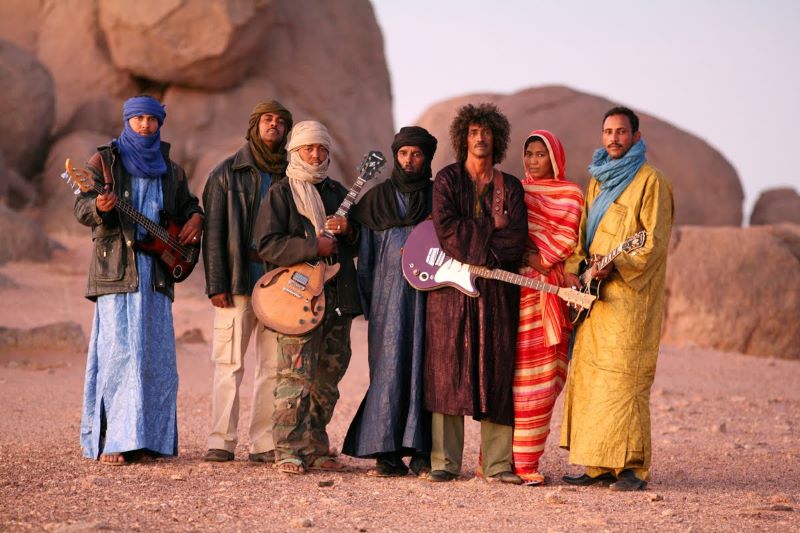
The desert navigators
Places of difference and of the other can be a source of our fears, until we allow them to cease being foreign to us. Music is one of those paths, like the kind brought from the Tuareg desert by the collective Tinariwen, pioneers of “desert blues.”
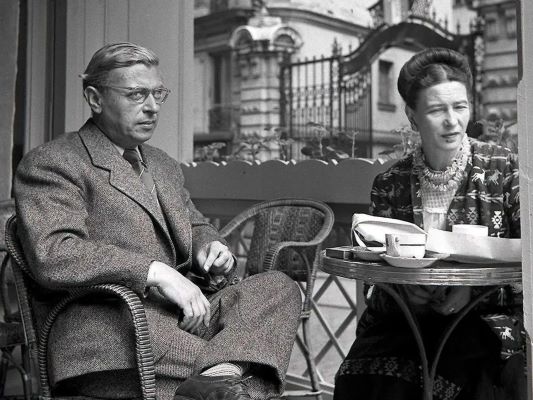
The French couple
The French couple are Jean-Paul Sartre and Simone de Beauvoir, one of the most influential intellectual pairings of the twentieth century. They sustained both an intellectual and romantic partnership for over fifty years, challenging social conventions and collaborating in the development and dissemination of existentialism.
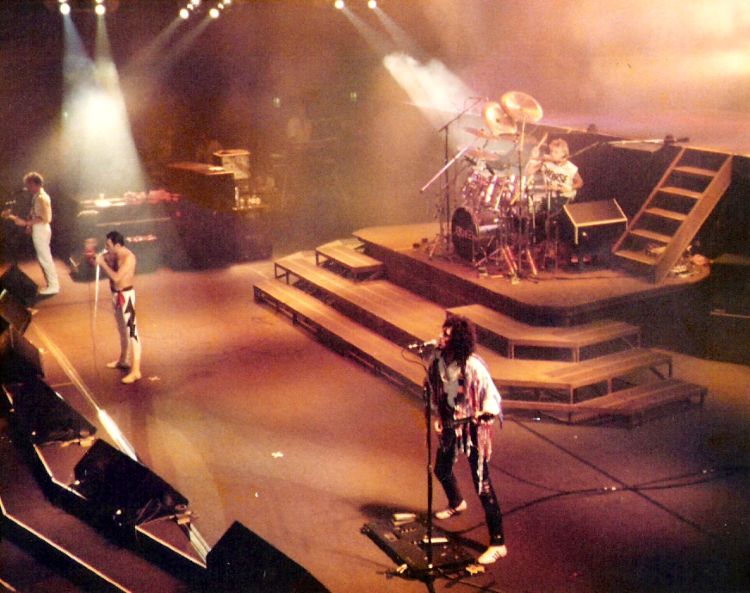
Bohemian & Rhapsody
Inspired by The Stranger by Albert Camus, as well as by other literary, musical, and cultural sources, “Bohemian Rhapsody” is one of the most iconic songs in recent music history.
Excluindo as imagens criadas pelo autor deste blog, as imagens utilizadas neste post têm as seguintes lincenças:
Jean Paul Sartre & Simone de Beauvoir: https://kab.m.wikipedia.org/wiki/Tugna:Jean-Paul_Sartre_FP.JPG
Queen by Thomas Steffan: https://upload.wikimedia.org/wikipedia/commons/d/d4/Queen_1984_011.jpg


Termos e Condições