
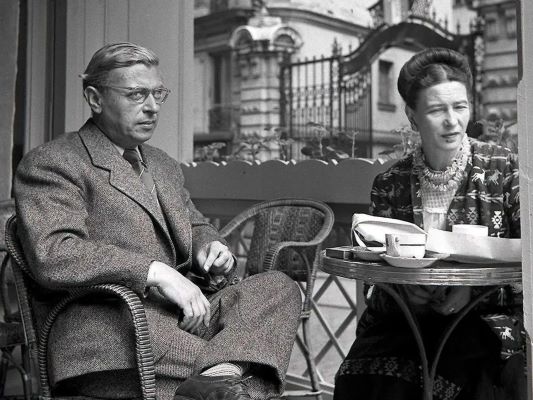
The French couple are Jean-Paul Sartre (1905–1980) and Simone de Beauvoir (1908–1986), one of the most important intellectual pairings of the twentieth century. They sustained both an intellectual and romantic partnership for more than fifty years, challenging social conventions and collaborating in the dissemination of existentialism. Together, they founded the journal Les Temps Modernes, which became a major platform for philosophical and political debate. The journal continued until 2019, when its director, Claude Lanzmann, passed away, the man with the weary, round face.
Sartre, an existentialist philosopher, writer, and playwright, developed influential ideas on freedom and individual responsibility. He is the author of Being and Nothingness and Nausea. Beauvoir, a philosopher and feminist writer, explored the condition of women in The Second Sex, a foundational text for modern feminism. She also wrote fiction, including She Came to Stay.
The idea that existence precedes essence feels like a delightful reversal of Platonic idealism, proposing the radical freedom of understanding ourselves as projects, free to realise ourselves within the limits of our human condition, independent of any supposed primordial essence. Yet this is no easy task. How is each of us to orient our life in a meaningless world? In a world without a God to dictate the rules, without externally imposed laws, without traditions pushing us into the safety of the herd?
Human freedom lies in accepting the responsibility of choosing between good and evil, and in having the courage to do so authentically. At a time when everything seems to alienate us, overcrowded cities, an extreme division of labour that drains meaning from work, disconnection from nature, lives reduced to virtual sociality, and the dictates of economic and political marketing, existentialist philosophy can help us regain our footing and push back against the falseness of our age.
In the video below from BBC, narrated by Stephen Fry, you can explore Sartre’s existentialist proposal in a clear and entertaining way.
Excluindo as imagens criadas pelo autor deste blog, as imagens utilizadas neste post têm as seguintes lincenças:
Jean Paul Sartre & Simone de Beauvoir: https://kab.m.wikipedia.org/wiki/Tugna:Jean-Paul_Sartre_FP.JPG
