The first week after departure, and the travel plan is already at risk of being changed. Everything went smoothly until we reached the port of Baleeira, by Cape Sagres, around lunch hour. It had been 93 peaceful miles, calm enough to allow for deep sleep.
As Nómada approached the harbour, we brought her head to wind and lowered the sails. We started the engine and slowly made our way toward the pontoons, the captain at the helm and I preparing the fenders and mooring lines. Then the engine sputtered and died. We tried to restart it – once, twice, three times – nothing. The wind, which blows there with stubborn persistence, began pushing us toward the Martinhal islets. The captain cursed under his breath and, with a resolute movement, whether born of anger or calculation, he ran to the bow to drop anchor in the hope of keeping us away from the rocks.
Suddenly, a jet ski appeared at high speed, coming from behind the islets, as if someone were filming a commercial. The rider, dressed in a dark wetsuit and mirrored goggles, passed close by Nómada, signaled to the captain, and shouted for us to throw him a line. With no time to hesitate, the captain obeyed. In a swift and coordinated manoeuvre, the man grabbed the rope with precision, fastened it to the back of the jet ski, and towed us safely into the harbour, pulling us away from danger.
He kept a firm pace until we were inside the breakwater and stopped only when he saw us secured with lines to shore. Then he tied up the jet ski. In quick, electric movements, he climbed onto the pontoon and headed toward Nómada at a brisk trot, his dark hair tied into a short ponytail bouncing with each step.
“Ricky,” he said, removing his goggles and extending a hand to the captain, his smile stretching a thin moustache. His accent was hard to place, as if it carried traces of several places. “I have a friend who can help you. He’s Dutch. The best mechanic in the region. Maybe the best in Europe.” And without another word, he speed off on the jet ski just as quickly as he had arrived, leaving behind a trail of foam and mystery.
A local fishing-boat skipper who had helped us dock noticed the captain’s wary look and came closer to reassure him about the mechanic’s competence.
“He’s right. The mechanic doesn’t speak much Portuguese, only arrived recently. But when it comes to engines, there’s no one better. He fixes everything. If you’re still here next Friday, the first of the month, you can see him at the Sagres market. He’s got a stall there now with all sorts of little machines. It’s mostly pendulum clocks that he buys and restores.”
The only marine mechanic available in the region was indeed the Dutchman named Chris Huygens. He showed up after lunch. Tall, thin, aquiline nose, a head of wavy blond hair that brought to mind David Coverdale on a late tour. He greeted us with an almost shy nod and got straight to work. In less than five minutes he found the fault, but the repair would only be ready in four or five days: we would have to wait for a part to be ordered.
“Hey, you not want be without engine at sea, right?” he said with a crooked smile. “You wait here, eat, drink, sleep. Then make the trip, yes?”
We accepted the days stranded in Sagres waiting for the part as one prolongs the anticipation of a pleasure, without thinking too much about the forced deviation from the plan. The captain kept himself busy with small maintenance tasks on deck, meticulous inspections of the sails, adjustments to lines that seemed imperceptible to any other eye. Sometimes he sat on the quarterdeck with a technical book in his hands, but more often he left it closed on his lap, staring at the horizon as if waiting for the wind to bring him something.
I would go ashore early in the morning and walk without haste to Tonel Beach. I took with me a notebook and a book of short stories but wrote and read very little. It was more a matter of being at the edge of the world, where the blue of the sky touches that of the sea. The cliffs of Sagres cast a heavy shadow over the sand, a dense presence, and there was a strong smell of salt air mixed with dried seaweed, as if aquatic creatures had marked their territory before retreating with the tide.
That was where I saw Ricky again, on the beach, giving a surf lesson. He wore a black wetsuit half unzipped and spoke to a group of four young tourists; they were German or Dutch, judging by the cadence of their speech. He explained the fundamentals of tides and wave reading with broad gestures and image-filled sentences. He wasn’t just an instructor; he looked almost an enchanter. The group listened, fascinated, laughed at his jokes, mimicked his movements. Then they followed him into the break, like disciples ready to learn new rituals.
I stood watching them, feeling the sun, already tilting southward, sweep across the beach and warm my skin. The sea that day was a gentle sequence of promises. There was no violence, only an almost mystical cadence. With every stroke, every attempt to stand on their boards, I watched bodies fall in a mix of desperation and faith. And when at last one of them managed to glide a few meters before falling, the joy was boundless, almost childlike. As if, for an instant, the whole world was a flat surface on which anything was possible.
There is something spiritual about surfing, a near-religious surrender to the rhythm of the sea. It is not merely about taming the wave, but about listening to it, knowing when to retreat and when to advance. Surfers wait on their boards as if in prayer: eyes fixed on the horizon, they listen to the secret language of the waters, search for signs, align themselves with invisible forces. With each fleeting glide, there is a revelation, ephemeral, yes, but absolute in the instant it happens. Perhaps that is what holds them: not the adrenaline, but the glimpse of a greater order, a dance in which body and world become a single movement.
“Surfing is dancing with attitude. Or attitude dancing, whichever you prefer.”
I startled at the surprise of someone voicing my thoughts. A man with sun-leathered skin, a dark beard framing his mouth – he reminded me of Subotai, that character from the Conan film – sat down near me with a board at his side.
“Gerry,” he said, greeting me with a shaka, the typical surfer’s gesture. He shifted his gaze to the group in the water. “Ricky’s got a gift. Not just for teaching, but for making them want to stay.”
“Have you known him long?” I asked, turning toward him.
“For a few years. Comes and goes. Spends a lot of time in Morocco. Slips into a few villages and comes back with redder eyes and a lighter spirit.”
He paused meaningfully.
“They say he carries heat in his pocket and mist in his backpack, you know what I mean?”
I nodded with an involuntary smile.
“He takes Huygens along sometimes, too. But that’s a secret. People around here don’t understand certain kinds of company.”
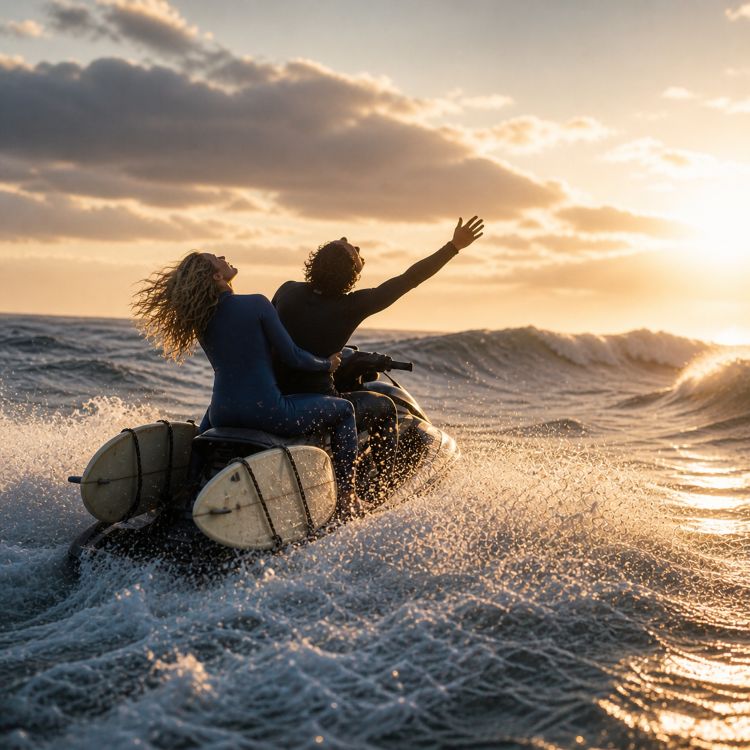
The following morning, I saw them together again, Ricky and Huygens, on a borrowed jet ski, with two boards strapped on with improvised cords. They laughed loudly, like men who wake already inside a dream. Ricky, standing, made a vague gesture toward the rising sun; Huygens held on to the seat with one arm and, with the other, raised something, perhaps a boombox, from which a distorted riff spilled out. They sped away, the jet ski slicing the surface like an arrow.
Yesterday morning, just after lunch, I heard heavy footsteps on the pontoon and the metallic clink of a toolbox. Huygens appeared with the part in his hands, still smelling of fresh oil.
“Today boat breathe again,” he declared, winking at me.
He didn’t explain how the part had arrived earlier than expected, and we didn’t ask. For three hours he worked in silence, his body buried in the engine as if diving into another creature. The captain watched his movements closely and, at a certain point, the two exchanged remarks, the kind that pass between those fluent in the language of the sea. When Huygens finally straightened up, sweaty and dirty up to his elbows, he smiled with quiet pride.
“All set. Engine sing like new.”
We carried out another check of the boat’s condition and tested the engine again. By the end of the day, we opened a few beers and sat talking on board.
“Where you go?” he asked between sips.
“The day after tomorrow? Santa Maria. About a week’s sailing, if we catch good wind.”
“You sailors only think about wind, not pay attention to waves.”
“Waves are for surfers. You’re a surfer, aren’t you?”
“It my passion. Not married, no children. Often melancholic, but waves be my company. I study waves all my life. Waves be everywhere. in sea, in air… Light is wave also. Everyone think wave is thing with one direction, but wave spread many directions, meet other waves and puff…” He made a clashing gesture with both hands and went on, almost spelling the words as if he had memorized them. “Constructive interference make wave stronger, destructive interference cancel wave.”
“Just like people,” the captain observed.
“Exactly!” the Dutchman pointed, with a broad smile. “You need know which people be good wave for you, right? That my life principle. Huygens principle.”
He burst into a long laugh, as if he had just grasped a cosmic joke.
“That why never married,” he added, with a shrug.
He invited us out for a drink at Ricky’s bar.
“Good music, good people. Surfers’ bar. There we forget engine and wind and everything.”
The captain stayed behind on Nómada, saying he still had some navigation calculations to do, but I went, driven by curiosity.
Ricky’s bar was easy to find, on a side street off Comandante Matoso, its façade hand-painted with a mural mixing psychedelic waves, Mexican skulls, and an octopus playing an electric guitar. A rusted sign, hanging from steel cables, read Onda Certa. Inside, the air was thick with salt, beer, and cheap incense. The walls were covered with broken boards, photographs of legendary manoeuvrers, and scribbles left by travellers from all over. One of those places where it always seems to be summer and no one is in a hurry to go home.
The clientele was a collage of suspended lives: sunburnt surfers, backpackers with vacant eyes, two bolder fishermen looking around with curiosity, and a few girls who might just as easily have been on holiday as running from something. There was complicity in the gestures and an intense informality, as if everyone there moved to the rhythm of the same tide. Yes, it was indeed an easy place to find. The hard part was leaving it with your senses intact. At a certain point, there was a slightly unruly joy in the air, as if Sagres were a free port between two storms.
Ricky appeared from behind the counter with a glass in his hand and that kind of smile that seems to have a light of its own. His dark hair was stiff with salt, his skin golden, his movements those of someone who knows the sea and imitates it. He embraced Huygens as one greets a part of oneself, and the two began to move around together, receiving pats on the back, murmured greetings, glances filled with something unspoken. It wasn’t just friendship. It was something else, a deep understanding, as if they spoke a language beneath all languages.
There was a kind of reverence around them. As they passed, conversations softened, smiles shifted tone. Ricky had an almost choreographic magnetism. Setting down a glass, lighting a cigarette, any trivial gesture gained weight. Huygens, with his lanky body and sharp eyes, seemed the complementary echo. Together, they resembled characters from an old film of surfer buddies.
At the height of the night, they both climbed onto a table and began singing a vibrant version of Whitesnake’s Here I Go Again. The crowd cheered them on enthusiastically, shouting a name someone had invented for them:
— H2 Ooh! H2 Ooh!
“Henrique and Huygens,” a scrawny young guy explained to me, his skin so weathered by the sun he looked as though he’d been in Sagres for years without ever leaving the beach. “Ricky used to be a champion, you know? Him and his brothers’ crew. Then came a wipeout. A bad rag roll he couldn’t come out of. He gave it all up.” He paused dramatically, as if revealing a sacred secret. “He came here and opened the Sagres School, but it wasn’t really about the swell… His specialty is making runs over to Morocco,” he whispered conspiratorially.
At some point, the music softened and the bar began to empty. I thought I’d take advantage of the moment to pay my bill and drift out with the rest, but Ricky set two shot glasses on the counter. An invitation to one more drink. He lit a hand-rolled cigarette with a dubious smell and leaned against the bar, speaking as if continuing an old thought.
“Do you want to know why I ended up here?” he said, after a long silence, his voice rough from tobacco and singing. “I’m not even sure myself. Maybe the wind brought me, like so many who drift through this place, or maybe it was the sea.” His mouth twisted at the trace of some painful memory. “Yeah, the sea is like a treacherous old lover: it swallows us without warning, spits us out without explanation.”
He paused, ran a hand through his hair, glanced at Huygens, who was saying goodbye to a group on their way out, and let out a brief, dry laugh.
“And then, he walks into my bar one day” he said, nodding toward the Dutchman. “As if he were just another customer. But I knew right away. Even with the sunglasses, even with that practiced smile… You open a bar at the end of the world, thinking the wind would take care of erasing what memory insists on replaying…” He shrugged. “You know what I like most about him? He dresses in light colours as if he didn’t know the world can be cruel. We sing and pretend that eternity can fit inside a rock song and a pint of beer.”
He looked at me with tired but lucid eyes.
“Of all the bars, in all the cities, in the whole world, he had to walk into mine.”
He gave a mocking little laugh, raised his glass, and toasted softly:
“To those who leave. And to those who come back when it’s no longer supposed to matter.”
Huygens joined us at the counter, and I took advantage of the interruption in Ricky’s soliloquy to make my escape.
“I have to go. The sea, even when it sleeps, demands punctuality.”
They fell silent. I couldn’t tell whether they were confused by my departure line or lost in something else entirely.
Early this morning, as I drank coffee on deck and prepared to write you this message, I saw them again. Ricky and Huygens, pressed together on the same jet ski, as if that narrow space between them were familiar and comfortable to them. They laughed with the lightness of those who share old secrets, the kind that don’t need words to stay alive. Two surfboards were strapped on with worn-out straps and more confidence than sense. Ricky drove leaning slightly back his body, one arm raised in the air as if saluting the gods of the sea. Huygens held him by the waist with easy familiarity, his loose hair dancing around his face. He shouted something the wind carried away before I could make it out, but Ricky answered with a brief, intimate laugh as if it were a joke they’d told a hundred times. The jet ski moved off toward the larger waves, not in search of adventure, but like someone returning to a place where they can be whole, even if only for a moment. Between them, there was a catalytic energy. And perhaps that was what kept them away from the eyes of the shore.
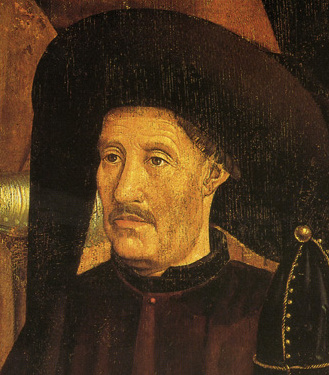
Ricky
A well-known figure from the period of the Portuguese Discoveries, Infante Dom Henrique (1394–1460), known as the Navigator, is a figure shrouded in some mystery.

Rain of Tears
Henrique & Huygens performed several songs, but it was their renditions of Whitesnake’s greatest hits that most excited the audience, such as Here I Go Again, Is This Love, and Crying in the Rain.

Huygens
Christiaan Huygens (1629–1695), the Dutch mathematician, physicist, and astronomer, distinguished himself through his studies of light and wave theory, and as a pioneer in the construction of pendulum clocks.
Excluindo as imagens criadas pelo autor deste blog, as imagens utilizadas neste post têm as seguintes lincenças:
Infante D. Henrique: https://pt.wikipedia.org/wiki/Ficheiro:Henry_the_Navigator1.jpg Por Nuno Gonçalves – From the Polytriptych of St. Vincent in the National Museum of Ancient Art, Lisbon., Domínio público, https://commons.wikimedia.org/w/index.php?curid=3426090
Whitesnake: Ash Newell https://maxmetal.net/2018/03/27/whitesnake-anuncian-nuevo-album-para-el-proximo-verano-2018


.jpg)
Termos e Condições