
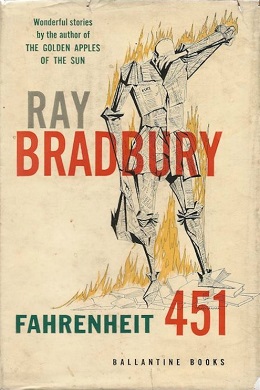
Fahrenheit 451, written by Ray Bradbury and published in 1953, is a classic of science fiction literature. The story takes place in a dystopian society where books are banned and burned by firefighters, whose role is to eliminate all forms of critical thought. The title refers to the temperature at which paper ignites—approximately 232.78°C—symbolising the destruction of knowledge. The protagonist, Guy Montag, is a firefighter who begins to question his role in society after meeting Clarisse, a young woman who inspires him to reflect on his life and the world around him, eventually leading him to rebel and hide books in order to preserve knowledge.
At a time when attempts at censorship are beginning to emerge in libraries—starting in the United States and the United Kingdom, and even in Portugal—it is all the more important to defend freedom in spaces such as libraries.
For those who enjoy cinema, the minimalist and stylised approach of François Truffaut’s 1966 adaptation offers a unique visual interpretation of the novel, with a score composed by Bernard Herrmann, the same composer behind Psycho.
All images used in this post, with the exception of those created by the author, are reproduced under the following licences:
Fahrenheit 451: https://en.wikipedia.org/wiki/File:Fahrenheit_451_1st_ed_cover.jpg


Terms & Conditions