
As night fell, Vacchia Meli retired to his cabin, probably still a little dazed by the lesson I had administered right across his… supraorbital arches. The Captain and I remained on deck, practising how to determine our position with the sextant. I knew he knew I was dying to throw myself at the subject that had been left hanging, as I told you, but I didn’t want to force the conversation.
Then, as casually as if he were commenting on the position of a star in the sky we were observing, the Captain said: “The reason Vacchia Meli is on board is that this is no longer about people. It’s about narratives in transit.”
The look on my face must have made it clear that I hadn’t caught the silent part of his thinking.
“You’re beginning to feel it, aren’t you?”, he asked.
I was more surprised by the sudden familiarity of his switching to an informal tone than by the question itself.
“The world began to warp a few decades ago. Or, if you prefer, to become subtly twisted, like a magnetic tape that has been badly rewound. And now stories are beginning to cross one another, and characters are jumping from one narrative into another. Narrative planes are colliding.”
“Like the narratives of the others we’ve met?”
“Not all of them, but yes. Abelard. Johnny Lucky, Jay Jay Russo, Bad Tom… Each of them is a narrative configuration that broke away from its original parallelity and found its way into yours.”
“Mine?”, I repeated, feeling that faint numbness that precedes existential panic.
“Or rather, ours, all of ours,” he corrected. “They’ve drifted into this parallelity in which we’re sailing, perhaps because this is the one that’s in transition. As though we were passing through an overlapping zone, a junction where narratives fold over one another. Perhaps this is the point before the point of no return, where it’s still possible to change the world.”
“Is that why this is happening now?”, I asked. “Is that why these narratives have started to shift?”
The Captain took a deep breath and looked at me with an uncertainty that contrasted with his usual self-assurance.
“We don’t know. Perhaps it’s because the axis of the collective narrative has given way,” he replied, looking first towards the horizon and then up at the sky. “If you ask me what I think, I’d say that the new technologies have created a narrative chaos which has somehow overloaded the different narrative planes. Our world no longer knows what story it wants to tell. There is no longer a hegemonic plot, no dominant genre. Everything is fragment and remix, version and parody. People live as though they were characters from different television series, each with an incompatible format. Some speak as if they’re in a reality show; others behave as though they’ve wandered out of a Russian novel. The system is overloaded.”
He sat down at the stern, putting away the sextant, and I did the same, my legs drawn up, my back resting against the gunwale.
“Abelard, for instance, is no longer just a medieval thinker. He’s also Bel, the former celebrity, now lost in a hermitage on Corvo. And the other three… I don’t know whether you recognised them.”
I shook my head.
“John Locke, Jean-Jacques Rousseau and Thomas Hobbes. Three giants of political philosophy who have slipped into the world of present-day politics.”
Suddenly, everything fell into place. Of course.
“The crucial question is how these crossings can affect the world. The impact that people like Vacchia Meli, or whatever you choose to call him, can have upon it.”
“And what did they do to him on the cargo ship? Or is it a submarine?”
The Captain sighed.
“It’s a submarine,” he admitted quietly. “We’re trying to soften the passage of these figures. Let’s call it ‘narrative realignment’.”
“And the other captains… are they too…?”
The Captain nodded.
“There are several of us doing it. Other captains are out there on different routes. Each with a role of his own.”
“The captains’ club. Peter Café Sport. The secret meeting…”, I murmured.
He nodded again.
“Yes. At first it was nothing more than a sailors’ game once we became aware of the crossings between storylines. Then we began to see their consequences and realised that something much greater than ourselves was taking place.”
He fixed me with a grave expression.
“Our planet is groaning. Human greed poses a real threat to its sustainability. These crossings between narrative planes may offer a unique opportunity to restore some measure of balance. But they could also prove catastrophic if certain characters are allowed to take hold of the global narrative.”
“So that’s what you’re preparing? A global revolution?”
The Captain smiled mockingly.
“‘Global revolution’ is rather too grand a term. But we are trying to connect the dots and weave an ever wider network. Corto Maltese, Nemo, Kirk… each of them is the guardian of a passage, watching over zones of intertextual crossing. We try to prevent narrative collisions and to ensure that wandering configurations either integrate peacefully… or dissolve.”
The thought of a narrative dissolving, even peacefully, sent a shiver through me. I didn’t even want to ask what he meant by that.
We sat in silence for a few moments, the sound of the sea filling the emptiness.
“And me? Where do I fit into all this?” I asked, as though I had only just remembered that I, too, was aboard the Nomad.
“Apparently, you may be one of the epicentres of the singularity. At least, crossings seem to occur around you with remarkable frequency. There are many who, like you, are trying to reconfigure themselves and, in doing so, begin pulling narrative threads from other parallelities.”
“So my identity crisis… is some sort of interdimensional magnet?”
“It’s more like a narrative torsion. A ‘perpendicularity’ in pulsation that attracts wandering configurations. You know when you take a bite out of a mille-feuille and the cream squirts out through the sides? The same thing happens to other narratives when the layer of your parallelity shifts. The other fillings come looking for you.”
I recognised Silva’s metaphor.
“And if I wanted to stop? To go back to ‘normal’?”
He smiled with compassion.
“There is no longer a ‘normal’. There is only movement. Or rather, there is only narrative. You can try to resist, but that will only create greater tension between the planes. The best thing you can do is to keep telling your story. To let your voice find whatever coherence is still possible among the figures that arrive, the traces they leave behind, and the enigmas that remain unresolved.”
I fell silent, reflecting on my condition. I was a free prisoner, wandering the world while paradoxically trying to shut myself inside a routine that no longer existed.
“And what is the role of the captains?”
The Captain paused for a moment.
“We are conductors,” he said. “Of characters, of passages, of meanings… Sometimes we help a narrative die with dignity. At other times, we welcome a new one.”
He noticed my unease, but continued in the same calm voice one might use to explain the meaning of a misfortune to a child.
“We’re always watching over the coherence and cohesion of the mille-feuille. And whenever one of the layers begins to squeeze its cream out too violently, we do everything we can to prevent a cataphoric explosion.”
“Like therapists?”
“Like guardians of fiction.”
The Captain stood up to ease the mainsail and then sat down again at the stern. He pointed towards the invisible horizon with his chin.
“There will be more crossings. Many names are on their way. Some you’ll recognise, others you haven’t even imagined yet. There are rumours that an ancient biblical figure is making the journey again by sea, and that a certain woman from antiquity has begun appearing in the dreams of several children. People speak of a narrative fissure that has materialised on the ocean floor. That’s what Nemo searches for on his voyages. In fact, it’s what all of us are searching for. But you… keep your eyes and your mind open. And don’t forget: tell everything. Everything you can, for as long as you can.”
I looked down at the water. For a moment, I thought I saw shadows gliding beneath the hull. I opened my notebook and wrote down everything we had talked about.
To add it to the narrative.
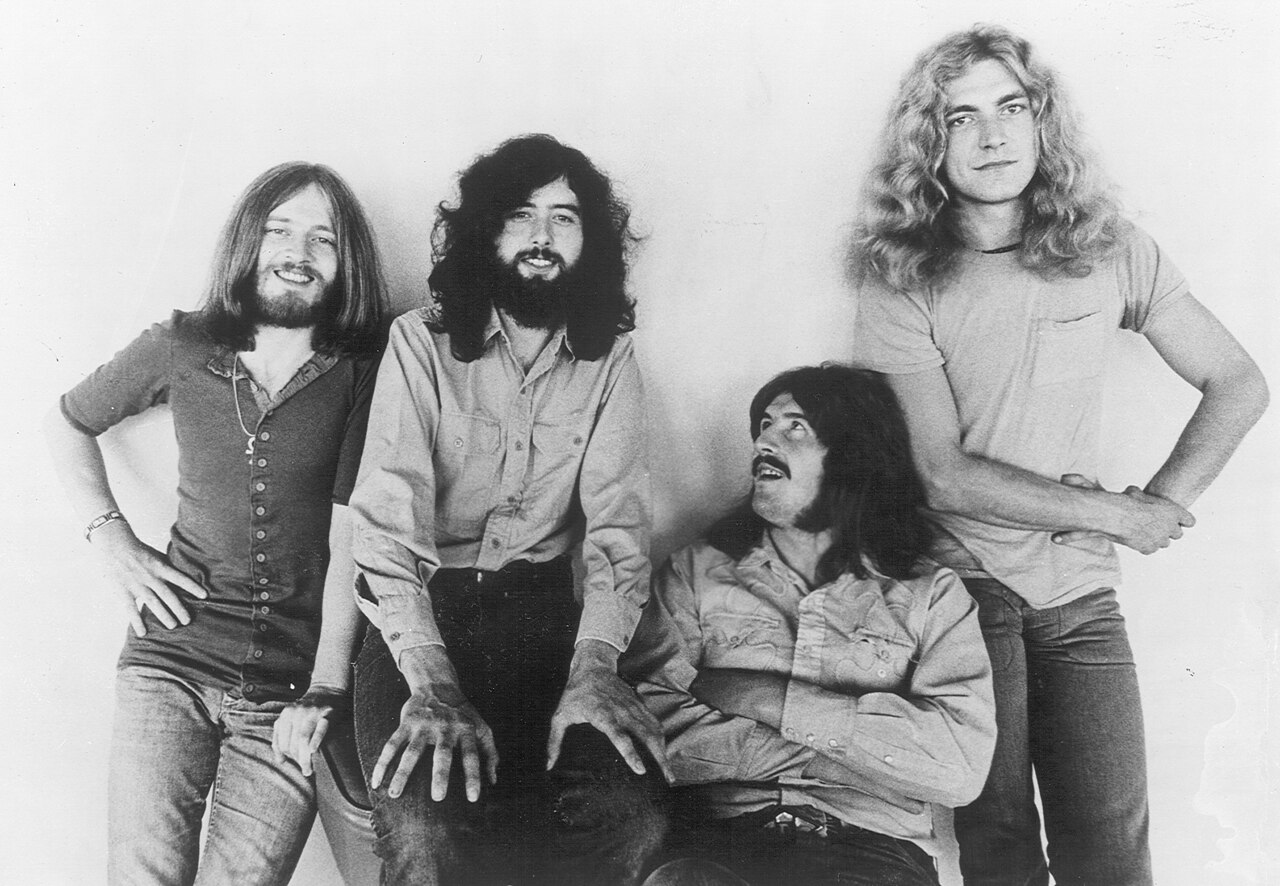
The journey continues
Ramble On is a song about journeying, longing, and the need to keep moving despite loss. Drawing on Frodo and Sam’s quest in The Lord of the Rings, its narrator presses on not because he has found the answers, but because standing still is no longer an option.
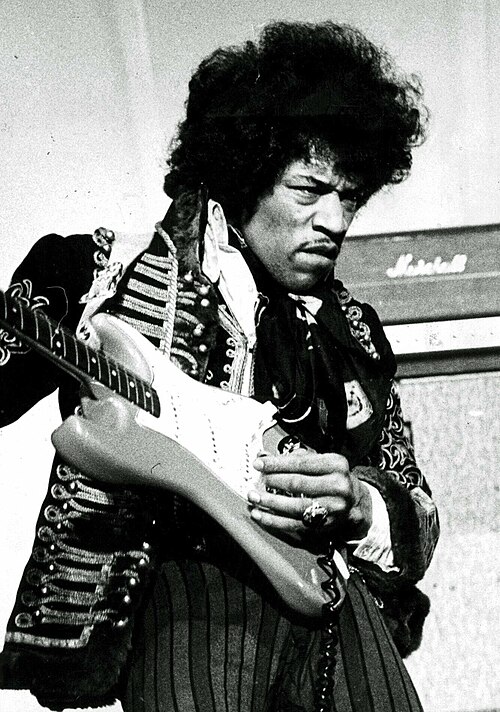
Along the watchtowers
Originally written by Bob Dylan in 1967, Jimi Hendrix’s version of All Along the Watchtower is the one that has remained in everyone’s memory and ears.

The man who sold the world
The Man Who Sold the World is a song built around an unsettling encounter between the narrator and a figure who appears to be, at once, both a stranger and a reflection of David Bowie himself. The lyrics explore themes of identity and alienation.
Excluindo as imagens criadas pelo autor deste blog, as imagens utilizadas neste post têm as seguintes lincenças:
Jimmy Hendryx By Original photographer unknown – e24.se, attributed to Scanpixtrelleborgsallehanda.se, Public Domain, https://commons.wikimedia.org/w/index.php?curid=175123540
David Bowie Por Mercury Records – aqui, Conteúdo restrito, https://pt.wikipedia.org/w/index.php?curid=3325310
Led Zeppelin Por Atlantic Records – Cash Box, September 11, 1971; cover pagehttps://www.ledzeppelin.com/photos/led-zeppelin/promo/1971-promo, Domínio público, https://commons.wikimedia.org/w/index.php?curid=151881780


Termos e Condições