Sorry for the interruption. I have more news, but I’ll tell it later. Let me finish this while it’s still clear in my head, before the details start slipping away. You’ve probably realised it already. It was a night that did not belong to this world. And the worst of it had yet to come.
I was trying to understand how I had ended up in the middle of Rua dos Mareantes, some distance from the entrance to “La Bohème”, when I heard a voice behind me. It was familiar, but warped, as if it were playing back from an old tape left too long in the sun.
“Look who’s here. You alright?”
I turned. They were all there. My old crowd. My childhood friends. I had not seen them together in years. Not since we were teenagers. Manel dos Frades, with those dark hollows under his eyes carved deep into his face by too many hours of work. Mac, soaked in perfume, the smell clinging to him like a shield against something he could not wash away. Barão, pale and thin, carrying himself like a fallen aristocrat who refused to admit it. And Mr T, straight out of Cebolas de Cima, still wearing the same worn T-shirt from his band’s last heavy metal tour, the skull faded but watching.
I opened my mouth to ask what they were all doing there together. They spoke first. All of them at once. The same question, in the same tone, like a chorus that had not quite rehearsed enough.
“What are you doing here?”
For a moment, I almost told them the truth. That I had been in a hidden room inside “La Bohème”, a place I had never seen before, with people who did not quite belong to this time. But something stopped me.
“Ah… I went to ‘La Bohème’… and now I’m heading home,” I said, checking my watch.
“Tonight? ‘La Bohème’ is closed. Paulo’s taken a few days off,” Manel said.
“That’s not…,” I started, then stopped. The words would not come out right.
“Have you smoked something… or taken a little something?” Mr T asked, smiling in a way that felt too interested.
“I haven’t smoked anything. You know I don’t. I just had a bit of absinthe,” I said.
Even as I spoke, doubt settled somewhere deep in my chest.
“Best we take her home,” Barão said, not moving any closer. “We’ve got work. The Factory’s waiting.”
“Factory? Work?”
“He means the nightclub ‘Fábrica’,” Mac said.
“But that shut down ages ago.”
“He’s wrong. We’re going to ‘Círculo’,” Manel corrected.
“But ‘Círculo’ doesn’t exist anymore either. Don’t tell me you’re going to ‘Outubrus’. Or ‘Café com Estória’. What is going on?”
My voice thinned out at the end, like it no longer belonged to me. I rubbed my eyes. Opened them again. Nothing changed.
Mac stepped closer. His smile stretched across his face, tired and fixed, like something painted on. He put his arm around my shoulders, just like he used to, and nudged me forward.
“Come on. We’ll take you home.”
At first, it felt normal. Then, it became anything but casual. I began to feel his fingers against my skin as sharp, pin-like pricks in my shoulder, tiny thorns piercing through the fabric of my jumper. The human warmth I had expected was absent. In its place, there was something rough and cold, like the touch of a dry root pulled from the earth.
Instinctively, I glanced over my shoulder and, for a fraction of a second, saw something I did not expect. Mac’s hand, so familiar to me, had changed. It was a black, clawed thing, grotesque and hairy, each nail smeared with something dark and sticky. The vision lasted less than a blink, and when I pulled away, it was just his hand again, normal, with the same bitten nails as always.
“Come on,” he said softly.
I breathed in slowly. My heart was beating too fast. “Someone had put something in my drink, that had to be it”, I thought. Something in the absinthe. Something that made the world shift at the edges.
We started walking towards the beginning of Rua do Miradouro, passed the Rubi stationery shop and turned at the corner by Bia’s bakery, which no longer displayed the “For Sale” sign. Across the street, newspapers hung in the window of “Os Jovens”. People stood outside, stretching their necks to read the headlines. Someone inside waved at me.
Then, a gust of wind swept past us and blew the whole scene like dry ash, and scattered into nothing in a single breath. I felt it pass through me and pulled up my jacket zip, hoping it might offer some kind of protection.
Mr T walked beside me, his boots creaking with every step. I glanced at him. I shouldn’t have. Beneath his skin, I could see his skull. The flesh seemed translucent, stretched thin over bone, as if trying to get out. His eye sockets were deep, bottomless pits, his half-open mouth revealed broken teeth, stained with decay.
Horror tightened in my stomach and I blinked… and he was normal again! But the skull on his T-shirt seemed sharper now. Staring at me with a silent hunger.
“You alright?” he asked.
I didn’t answer. I couldn’t. My legs just kept moving on their own..
The lights on Rua Antão Girão flickered in erratic bursts. Something pulsed beneath the city, under our feet. Around us, the shopfronts shimmered. Inside them, shapes seemed to move. And then there was movement! In the windows, I saw faces that did not belong to anyone alive, like old goalkeeper Batista sweeping the floor of his stationery shop. I opened my mouth to speak, but realised my friends, walking beside me, seemed not to notice anything. Or worse, they seemed part of it.
“You’re nearly home. We turn left up there,” Barão said.
I tried to speak, but I could only move my head denying what I was seeing around me. Finally, words came at last in a broken whisper.
“But I don’t live there anymore.”
No one answered.
Barão, ever elegant, moved ahead. Too smooth. He turned back and smiled, his teeth sharp. A wave of panic rose in my throat like bile. I glanced at the others, hoping for some reaction, some sign that they saw it too, but none came. And then I caught our reflection in the next shop window. We were walking side by side… but Barão wasn’t there.
I had seen it. I knew I had. But before I could focus, Manel grabbed my arm with sudden force and pulled me away.
“Careful!” he said, almost laughing.
The way he moved was too quick, too deliberate. I looked at him. The circles under his eyes had deepened into pits. The skin around them looked dry, cracked. His eyes were losing their colour, turning glossy, dark. And his hand… Cold. Not just cold: dead.
I tried to pull away. He held me. I blinked. Everything was normal again. His smile. Mr T laughing. Barão ahead of us, walking like nothing had happened.
I thought again of the absinthe and its damned green fairy
We kept going. We entered Major Afonso Pala Street and it all got even worse – Fernanda weighing fish with too much blood on her hands, Tio Jaquim laughing uncontrollably with his mouth open wide, too full of teeth; the Girassol snack bar burning from the inside, people trapped behind the glass, pounding, screaming, unheard… The feeling of claustrophobia was almost unbearable, walking through a nightmare that only I seemed able to see.
We stopped.
“Here we are. You’re home.”
I took a deep breath, staring at the building, measuring the atmosphere around us. We seemed to be alone.
“This isn’t my home anymore,” I said quietly.
“This will always be your home. Your memory is your narrative of the past, and it shapes your identity. Your essence may stem from your existence, but your identity is the memory of your experience, the story you keep rewriting over time. And this house is the first mark of that identity.”
It was the boarding house where I had grown up until I was sixteen. You know that, don’t you? I stood there looking at the old two-storey building, its façade darkened and worn by time, and felt it all rising back up at once, not as memories exactly, but as something thicker, heavier, then flooding in from all sides: the smell of grilled fish drifting from the tavern with its saloon-style doors, the bar with the oversized table football, the sour-sweet mix of wine and fried meat, the sawdust scattered across the floor, the Fruto Real bottle caps with their Spider-Man decals, and between the two taverns the narrow middle door and the steep staircase, and the memory of climbing it on my father’s strong young shoulders – there was a photograph of that – and my mother waiting at the top of the stairs, posing like a Hollywood star, her skirt short, her legs impossibly graceful – another photograph, though not in colour – and I felt an almost unbearable urge to go back up there, to climb those steps again and walk through every room and corridor as I had done years before for the last time, crying through that abrupt, senseless farewell, trying to gather everything, every smell, every sound, every fragment of a life already gone, packing it inside me until there was no space left.
The wooden door creaked as I pushed it open. Behind me, the others did not move. They remained in the half-light, still and silent, like figures cut out of shadow, watching. Waiting.
Inside, the smell came first. Warm wax. Damp wood. Stairs scrubbed too often with bleach. The floor creaked beneath my feet in exactly the same places it always had, as if it remembered me. I crossed the hallway where guests used to come and go, the walls still lined with those small paintings of Parisian scenes the former owner had bought on that trip with his lover, and somewhere, though I could not see it, a pot still steaming on a switched-off stove released the faint, comforting smell of coffee drifting into the sitting room. I expected to find my grandmother there, sitting as she always had, but there was no one. Only the sound of my own footsteps, too loud in the emptiness. Even so, the air felt crowded, thick with something I could not see but could almost touch, as if the past had not left, only withdrawn slightly, waiting for me to notice.
Then I heard it. Laughter. A child’s laugh. High, clear, unmistakable.
I felt the cold move through me before I moved at all. I followed the sound down the corridor, aware of the doors on either side, closed but not fully, like eyes pretending to sleep. Beyond the glass door at the end, something moved. A small figure. A girl in a white dress, light brown hair, running barefoot.
My heart lurched. I knew her.
I called out, but she didn’t turn, didn’t slow, and I found myself running after her, stumbling on the rugs that curled up beneath my feet, catching me as if they did not want me to pass. She climbed the stairs laughing harder now, delighted, as though this were a game we both understood, her voice echoing ahead of me, stretching the space between us. I took the steps two at a time, breath tightening in my chest, and saw her slip into one of the rooms on the left, the room where I had spent so many afternoons reading, thinking, hiding from everything, with my first cat curled beside me.
I stopped at the doorway. Something cold breathed out through the gap. I pushed the door open.
She stood in the centre of the room, her back to me, perfectly still now, as if she had been waiting. The air felt wrong, thick, resistant, as though I were pushing through something invisible just by standing there.
“Hello…?” I said, tentatively.
She turned. And something inside me gave way.
It was me. It was me, but not right. Not alive. Her skin was pale in a way that had nothing to do with light, almost translucent. Her eyes were wide and fixed, cloudy, empty, as if whatever had once looked out from them had long since left. Her lips were parted, frozen in something that might once have been a smile.
An eight-year-old corpse.
The floor trembled. Not violently, but enough to make it clear that nothing was stable anymore. The walls began to peel, slowly at first, then faster, strips of dead rotten skin. I stepped back outside the room into the hall. The smell hit hard. Mould, rot, something older than both. Then the ceiling cracked in a long-jagged line that ran from the end of the corridor towards me.
A ran straight to the stairs feeling the noise behind me peeling the hair of my neck. The steps were no longer solid beneath my feet; they gave way, soft and damp, moss spreading under my hands as I tried to steady myself, and I slipped, sliding down toward the entrance of the sitting room as the whole house seemed to sag inward, collapsing into itself.
Voices rose around me as I ran. Not from one place, but from everywhere. From the walls, the floor, the beams above. Fragments of conversations I had heard as a child, arguments half remembered, laughter that broke off too suddenly, crying muffled behind closed doors. Figures moved ahead of me, crossing the corridor, some familiar, all warped, people I recognised but who no longer belonged to the living. I pushed past them, not sure if I touched them or if they passed through me, trying only to reach the door.
The space stretched as I moved, each room opening into another that should not have been there, furniture broken, pictures shattered across the floor, doors hanging at angles that made no sense, the whole place bending into something that was no longer a house but a trap built from memory.
I reached the entrance hall at last. The door was soft under my hands, rotten, giving way as I forced it open, and I stumbled out into the street, falling onto the cold pavement, the impact knocking the air out of me.
For a moment, there was nothing.
Then I turned.
The building stood there as it always had in recent years, closed, silent, its windows shuttered, the front door secured with chain and padlock. No movement. No sound. No sign of anything that had just happened.
And my friends were gone. All of them.
I stayed there on the pavement recovering, breathing slowly, trying to steady myself, telling the same thing over and over again. It was the absinthe. It had to be. Or something in it. Something someone had slipped into my glass.
That was when I heard it. A throat clearing. Close. Too close. I turned, but there was no one there.
Then something shifted in the air. Not appearing exactly, but condensing, as though a shape had been there all along and was only now deciding to show itself. A figure took form slowly, tall and thin, with the look of someone who had left most of himself behind somewhere six feet under. His jeans clung to him like a second skin, too tight, too still, and his long hair carried the stale, heavy smell of cannabis. His eyes did not quite focus, drifting slightly, as if he had only just remembered how to stand upright.
He cleared his throat again.
“Whenever you’re ready, we can begin.”
Begin what, I thought, though by then I already suspected the answer would not help.
“Who are you?” I asked.
“I’m Janus.”
Of course. That made perfect sense.
“I’ve got everything ready. Even the design.”
Fear had slipped away from me by then, replaced by something duller, almost curious. I was now sure none of this was real.
“And what’s the design?”
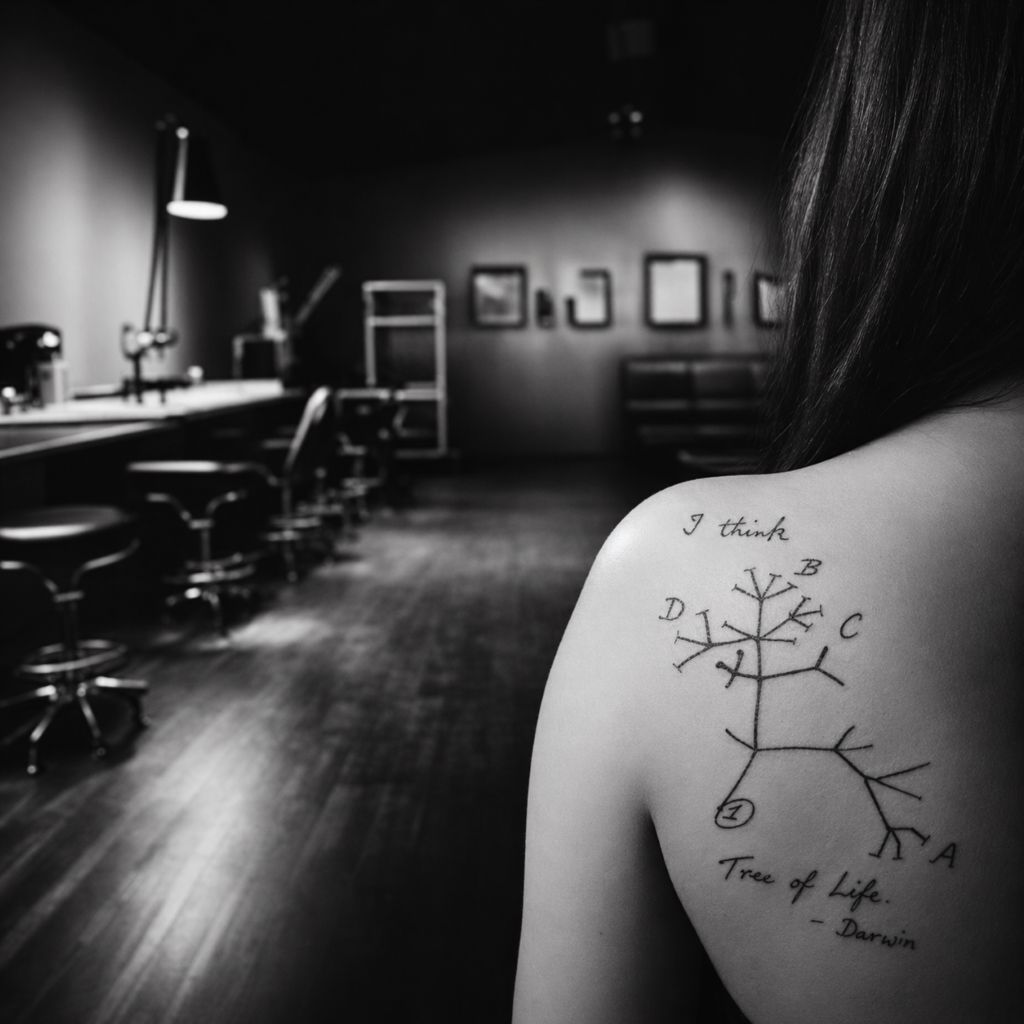
He pulled a crumpled sheet of paper from his pocket and held it out. A tree-like diagram, lines branching out in uneven directions, something scribbled at the top that I could not quite read.
“It’s the tree of life,” he said.
I looked at it again.
“Really? It looks rather dead to me.”
He smiled faintly.
“It shows how one point becomes another, how the past reshapes itself into the present. And how the present must change to meet the future.”
I said nothing. There did not seem to be anything left to say. He gestured for me to follow him, and I did. The tattoo parlour was there on the corner, exactly where I remembered it to be.
“Sit,” he said. “Where do you want it?”
“I don’t know.”
“It hurts less on the upper back.”
Less visible. More personal. I nodded.
“Sit facing backwards. You’ll need to take off everything from the waist up.”
Of course. I undressed and sat stiffly, feeling faintly ridiculous.
“You’ll need to lean forward.”
His hand pressed against my shoulder blade as he lowered the chair, leaving me bent forward, supported by the backrest.
“Comfortable?”
“Yes.”
I caught my reflection in the mirror and laughed, because I looked absurd, like one of those men at the gym posing without realising it, and the laughter came out wrong, thinner than it should have been.
Then the machine started. A low buzzing filled the room. I felt my heart pumping fast, realizing how vulnerable I was. “The absinthe”, I prayed.
Cold spread across my back first, then deeper, and something inside me locked into place. My fingers dug into my knees, my breath stalled halfway in, my body stiffening as if it no longer quite belonged to me. The needle touched my skin, a small, precise pain that should have been easy to ignore, but instead it grew, not sharper but heavier, pulling me downward, minute by minute.
The room dimmed. Or I did.
I felt myself slipping, not falling but passing through, through the chair, through the floor, through the cement beneath it, into the earth below, layers folding over me – household objects, a skeleton with hands and feet bound by a thin rusted chain wrapped in the fragments of a burial shroud, more domestic remnants, the ruins of another building, stones from a collapsed wall, fish bones and Roman artefacts and finally, the salty sand of the sea.
I woke with that taste of saline still in my mouth, half-fallen across my bed, my waist holding me from collapsing completely, with no idea how I had got home. The room was already warm from the sun, so I realised it had to be mid-morning. I hauled myself upright like a weightlifter and forced my sluggish body to shuffle in small steps to the bathroom, where I splashed my face with plenty of cold water. When I saw my eyes in the mirror, the memory of the previous night began to return and I remembered the tattoo.
I turned, looked over my shoulder. It was there. Exactly as he had drawn it.
Did you see the image I sent you? Because here’s the thing. If there is only one problem in all this, it is that the tattoo was done by someone who does not exist. You remember the place. The shop across from the wine cellar. It closed ten years ago.
So how is that possible?
I wrote everything down as fast as I could, before anything slipped away, before I could convince myself it had not happened. I spent the rest of the morning pacing, checking, thinking, trying to decide what was real and what wasn’t, and one option kept returning, quiet but persistent. Run away.
In the end, I called Silva. You know him, h has always been there, one of the few people I trust since childhood. We arranged to meet this afternoon so I can tell him everything.
He’ll be calling again soon to decide where. I’ll tell you what happens next.
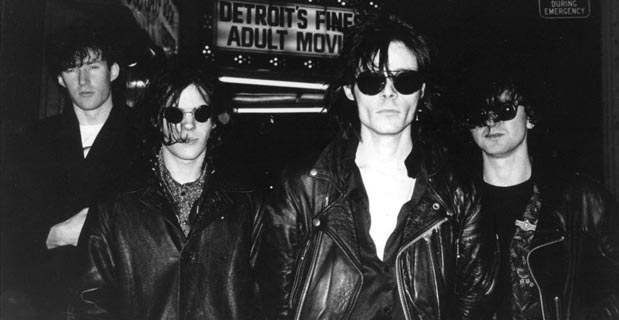
To the sound of the blessed Sisters of Mercy
From Ribeirinha do Sado to Fábrica, with a stop along the way at TGV, Setúbal’s nights pulsed with industrial rock.
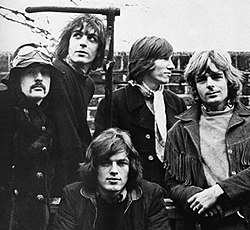
Civic Education
To the sound of helicopters, the dance floor opened in Arrábida and everyone seemed to fly with the Seagull. All that remained were a few bricks.
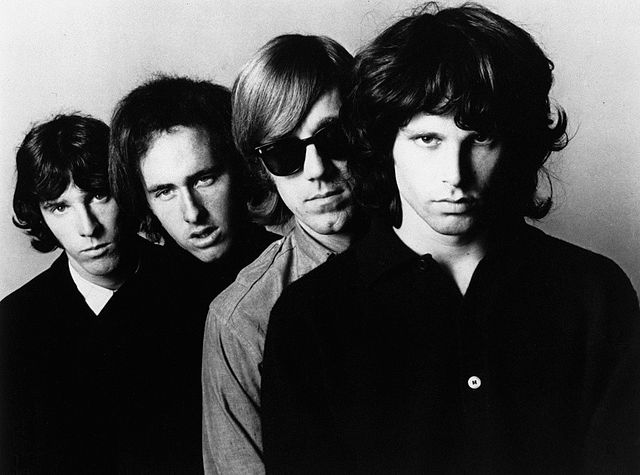
The “Dancing Days” Matinées
For many, their first experiences of nightclubs came during the matinées at “String Fellows” and “Leo Taurus,” where the playlist was the defining hallmark of each venue.
Excluindo as imagens criadas pelo autor deste blog, as imagens utilizadas neste post têm as seguintes lincenças:
Sisters of Mercy: Jill Furmanovsky & Ruth Polsky https://en.wikipedia.org/wiki/First_and_Last_and_Always
Pink Floyd: Unknown author https://www.imdb.com/pt/name/nm0969139/
The Doors: Joel Brodsky https://commons.wikimedia.org/wiki/File:Doors_electra_publicity_photo.JPG


Termos e Condições